Fifth Gear Sound Funny on 86 1200 Goldwing
.ashx?h=493&w=740&la=en&hash=1A14DB552483DAAA6EB52D5073835E478D50F277)
Additional reporting: Michael Isle of man
Imagine if someone made a motorcycle quick shifter that really worked besides as you hoped in every state of affairs? Accurate, seamless gear shifts with the simply the slightest tap on the controls. Imagine likewise if the controls were on the handlebar and then changing upwards or down, even at full lean angle could be done without fuss or worrying about getting your boot stuck between lever and tarmac?
Imagine likewise that the aforementioned gearbox did away with the need for a clutch lever and, at the everyman of low revs was unable to stall? How cool would information technology be to filter through wearisome moving traffic without needing to constantly plume the clutch? How amazing would information technology exist when riding off road to be able to descend a near-vertical muddy gradient and only alter downwards a gear without needing to shut the throttle or run a risk breaking traction past pulling in the clutch lever. And, how good would information technology be on a big touring motorcycle to change gears upward-and-down without your pillion head-butting the back of your helmet?
So, here's a thing. Honda's Dual-Clutch-Transmission (DCT) does all of the above and it does them in the most subtly engineered mode. DCT is as big a revolution in motorcycle control equally information technology must take been in the early on 20thursday century when gear-irresolute went from mitt controls to feet and clutch control went from foot to hand.
.ashx?h=493&w=740&la=en&hash=478005B64ED703EF8F02C0FF79EBAF9DEA676446)
Discrete grey paddles on the lhs switch gear control the quickest quick shifter you'll ever use
DCT, when used in 'manual' mode – changing gears with a couple of small paddles on the left-hand switchgear – is but bright. Hard on the gas it makes every (and I hateful every) other quick shifter on the planet feel clumsy and a waste product of money. It's ability to run at low revs and swap betwixt smooth drive and no drive, without needing a clutch lever is a revelation in heavy traffic. Every set up of traffic lights becomes a elevate race you know you lot could win, and two-upwards riding is a pleasure. DCT should exist the device that every single rider has at the top of their options list.
And so why do and then many riders (and especially then many cycle reviewers) detest it?
.ashx?h=493&w=740&la=en&hash=336A8C18A4426086094566EF87B7C4DFC55797DE)
RHS switchgear selects auto modes (ignore these) and manual pick (on the rear of switch cluster)
The answer is simple. The organization is built to be an automated gearbox, not a transmission one. Developed by the car industry, the transmission shift facility is a sideshow in cars, but absolutely the reason it works so well in bikes. And, sadly, the auto function on Honda's DCT takes a long fourth dimension to go used to. It works much better on some bikes than others and, even one time you've forgotten about it and just get on with riding, there volition still be the odd occasion when it is in absolutely the wrong gear at a moment when information technology really matters.
If Honda had launched DCT as a handlebar-controlled manual quick shifter and not built the auto-part into it, we would have all been raving about it, other manufacturers would have been compelled to build their own version and foot-alter gearshifts would already be a thing of the past. Sadly, because it defaults to auto-mode when you engage information technology, virtually riders come away confused at best, and usually much worse than that.
When was DCT invented?
This unique technology first appeared in dealerships across Europe in 2010 on a VFR 1200F, meaning 2020 already marks a decade of existence, during which time over 140,000 Honda motorcycles equipped with DCT have been sold in Europe. In 2019, 45% of Africa Twins and 67% of Gilded Wings were sold with DCT which the company puts downward to "a constant development of the engineering science, with refinements to the smoothness and timing of the gear shifts."
The system, updated in 2019 to link with an IMU (Inertial Measurement Unit of measurement), is available on seven models in Honda's current line-upward: NC750S, NC750X, Integra, VFR1200X Crosstourer, Africa Twin, X-ADV and Gold Fly.
How does DCT work?
In essence, in that location are two gear shafts. I containing gears 1,iii and 5 and the other with ii,4 and 6. Each shaft has its own clutch and the next gear is pre-selected while the previous i is running. This takes the split-2d moment of transition out of every gearchange and also makes it much smoother. And because it's controlled electronically, not physically, at that place are no microswitches or clunky engineering to cutting the throttle etc. Even when you attempt and fool DCT by manually irresolute down while still accelerating, the shift is nonetheless almost instantaneous and equally smooth as yous like.
For a more detailed description of DCT'southward performance click hither.
.ashx?h=493&w=740&la=en&hash=64F5EB4E28601DF5C75205BD5FD8E80E9917CC8E)
2010 VFR1200 was the first Honda to get DCT
DCT model history
The showtime generation DCT launched on the 2010 VFR1200F was awful in motorcar fashion – irresolute up far too early in the 'D' setting and not much better in Sport mode. Honda didn't aid matters by launching DCT on a typical launch-blazon twisty German mountain route. Nosotros were going into tight, slippery (information technology was raining) 2nd-gear corners with the wheel still in fifth gear, only for it to alter downwards to 4th or 3rd right at the wrong moment, leant over, when you'd least wait it.
In manual style it was brilliant, and I came away converted in part.
By the time the VFR1200 motor arrived in the Crosstourer a couple of years later Honda had sorted out the algorithm and the auto gearchanges were more considered. Because the VFR motor has and so much torque it didn't really affair if you were cornering in 4th because in that location was enough drive to pull you round.
2016's reborn Africa Twin seemed a weird choice of bike for DCT, but it turned out to be a stroke of genius. With even better-adult algorithms, the organization worked well off-road, fifty-fifty in auto-manner considering while navigating bumps, boulders and muddied trenches it turns out that non besides having to worry almost changing gear is a very good affair.
And by the time DCT striking the 2018 Gold Wing (where it is also linked to the riding modes), Honda had got the system pretty-much perfect.
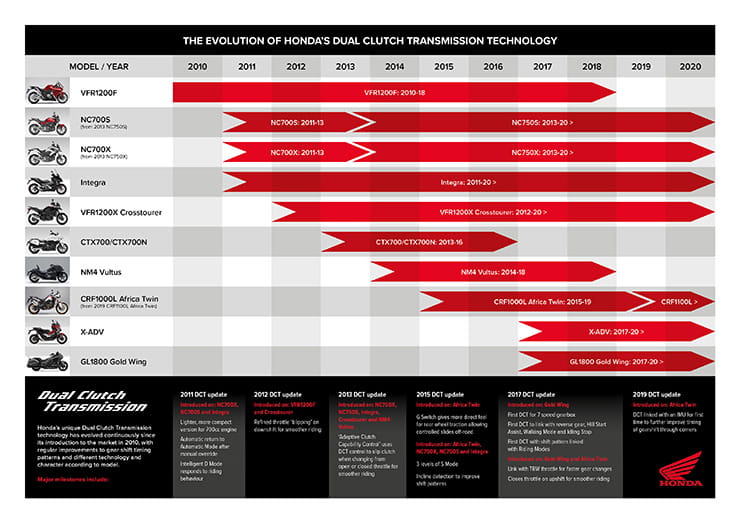
Above: the history of DCT-equipped Honda models
The only fly-in-the-ointment is on the NC700/750 range, where it works brilliantly in manual mode for all the reasons mentioned in a higher place but is awful in car-mode. It's the aforementioned problems equally the early on VFR1200; changing upward far likewise early on and holding onto gears for besides long when slowing down. One simple instance happened to me the other day on an 10-ADV adventure scooter (which uses the NC750 driveline). Going into a mini-roundabout in the right-mitt-lane, at 20mph it had but dropped down to fourth gear. As the road opened-up, the car alongside me needed to overtake a dawdler in forepart of him and then started to pull out into my lane, having failed to spot the world'due south brashest super-scooter alongside. No worries. I cracked open the throttle, just because the DCT had already changed up to 5th gear (at less than 30mph) the not-really-torquey-enough motor only bogged down, accelerating fifty-fifty more than slowly than the car alongside.
Without the low-rev drive in high gears that the bigger DCT motors take, the X-ADV was vulnerable.
I could (and should) have just tapped the manual downshift button a couple of times to appoint 3rd gear for some brisker acceleration, but I'd slipped into motorcar-mode and was lucky to get away with it.
The benefits of DCT
"Each model fitted with DCT has unlike shift timing. For example, the X-ADV is much sportier than on the Integra, as it upshifts at college rpm and downshifts also at a higher rpm for more engine braking," says Mr Dai Arai, DCT Chief Engineer. He continues by talking about the benefits of the system, "The biggest thing for me is how much brain 'bandwidth' it frees upward to use on what is most enjoyable about riding – cornering, looking for the right lines, timing your braking and acceleration. The other things is that it is both easy and direct. 'Easy' meaning no need to use a clutch in slow traffic, no adventure of stalling, no bashing helmets with a pillion. 'Straight' being the speed of the gear alter, the ability to utilise the triggers, and, as I mentioned, to concentrate purely on your riding."
Other automatic bikes we ignored
Honda has history with automated gearboxes. In the late-1970s they congenital a CB750 and CB400 with proper automatic gears including a car-type torque convertor. Aimed more often than not at the American marketplace they were heavier, slower and less economical than the standard manual bikes and more expensive too.
Moto Guzzi also built a car-type auto version of their V1000 in the mid-1970s. it was equally slow, thirsty and uninspiring to ride and besides consigned to the quirky side of motorcycling's historic garage.
.ashx?h=493&w=740&la=en&hash=D74FDBBD89AEAC9A2166C742F4CE223E7A76183C)
Yamaha's get-go-generation of semi-automatic FJRs besides grand a fleck of getting used to
Yamaha FJR1300AS
This was an interesting 1. The semi-automated FJR1300 arrived in 2006 and was essentially a standard FJR with a fancy automatic clutch. The passenger had to modify gear with either a foot lever or mitt paddles, but there was no clutch lever and it didn't stall when you came to a stop.
It likewise didn't automatically drop down to first gear at a standstill either, and then yous had to be careful not to try setting off in 3rd gear.
Once moving the FJR'due south system worked well, merely at low speeds (filtering through traffic for example) information technology could be clumsy and clunky. Plus, setting off from rest – getting a heavy 140bhp sports tourer off the line took some exercise and U-turns were pretty-much impossible.
The problem was that the just-off-the-throttle response on a bicycle is critical and, until you don't have a clutch, you don't realise how much you lot rely on it. Honda'southward DCT is almost perfect in this crucial area.
.ashx?h=493&w=740&la=en&hash=9C961233DD2D296127CC30997EE4CBAD21A9792D)
Aprilia'south Mana 850 had a scooter-mode CVT with a chain terminal bulldoze
Aprilia Mana 850
Similar an enormous twist and go, Aprilia's 2007 Mana had a chugalug-bulldoze, scooter-mode CVT (continuously variable manual), which could either be used equally a full automated or a pseudo-7-speed-manual using preset positions on the drive cones. The system worked really well and deserved to be more successful than it was. Sadly, the Mana didn't find a huge audience in the U.k..
To hear more almost the DCT gearbox and to see one in activeness, register for the Honda LIVEstream result taking place next calendar week where we introduce the latest Golden Wing and Africa Twin flagship models on the Honda UK YouTube page
Commodity originally published 24/ten/19
Source: https://www.bennetts.co.uk/bikesocial/news-and-views/blog/honda-dct-bikings-biggest-most-misunderstood-step-forward
0 Response to "Fifth Gear Sound Funny on 86 1200 Goldwing"
Post a Comment